Showing posts with label Milwaukee. Show all posts

Monday, August 22, 2016

Trump jiving about connecting to black people


The remains of  a gas station torched during civil unrest in Milwaukee
 
What a funny way Donald Trump has of reaching out to black people. The Republican presidential nominee came to Milwaukee and, skirting black neighborhoods, drove out to the lily-white suburb of West Bend to urge African Americans to vote for him – a perplexing pattern he has since repeated in Michigan and North Carolina.

In the West Bend speech he accused Hillary Clinton of “talking down” to African Americans. But what do you call lecturing people without even bothering to look them in the eye? In contrast, Clinton talks face to face with African Americans.

The real estate tycoon could have done so, too. Coming to town in the wake of the turmoil in the Sherman Park neighborhood, where businesses were torched, he could have met with, say, business owners there – a gesture that would have packed more meaning than the empty, albeit clamorous, rhetoric that he spewed in West Bend.

Trump’s black support barely registers in the polls. He’s clocking in at one to two percent – the worst showing ever for a GOP standard bearer. So it’s understandable he would want to boost those numbers. But the bizarre way he’s going about doing it makes you wonder: What’s his game?

There is a history here. The GOP is, as Trump himself has reminded us, the party of Abraham Lincoln, who freed the slaves. Thus, black people were solidly Republican after the Civil War. Franklin Roosevelt’s New Deal, though, drew most African Americans to the Democratic Party. Still, a sizable minority remained loyal to the GOP.

Richard Nixon fixed that, adopting what’s known as the “Southern strategy,” which involved winning office by appealing to whites turned off by the Democratic Party’s embrace of the civil rights agenda. The strategy chased many of the black loyalists out of the Republican Party. But the thinking was that the party gained far more in white votes than it lost in black votes.

That thinking was correct, with an emphasis on “was.” Now, due to racial changes in the population, that strategy causes more losses than gains – the reason why wise men and women of the party have called for a shift away from the strategy.

They face a major roadblock, however. Remember the white voters the party drew by appealing to anti-black sentiment. Well, now those voters make up a vital part of the Republican base, and they like the Southern strategy just fine, thank you. Immigration reform? No way, José. (Anti-black people tend to be anti-brown, too.)

Trump has exploited this ambivalence in the Republican Party. Rather than abandoning the Southern strategy, he has doubled down on it. For instance, thrilling the Republican base, the reality show star has called for a ban on Muslim immigrants and the erection of a wall along the Mexican border and, of late, has insinuated that black people cheat at the polls. No wonder his candidacy cheers white supremacists, like former Ku Klux Klan Imperial Wizard David Duke.

Protesters greeting Trump at a stop he made in downtown
Milwaukee for an interview with Fox News talker Sean
Hannity, before the candidate's trip to West Bend
The Southern strategy, America learned, still has enough juice to win the Republican presidential nomination, but at a high cost: It chases away so many people of color and fair-minded whites that it imperils victory in the general election.

So Trump comes to a white suburb in the hypersegregated Milwaukee area to connect with black voters. His rhetoric thuds false. A true dialog would take place face to face, and it must begin with an apology from the showman about his fanning racial fears for political gain.

After all, many African Americans have a hard time forgetting that Trump helped lead the charge to foist an aura of illegitimacy onto America’s first black president. Trump noisily demanded to see Barack Obama’s birth certificate, as if the commander-in-chief was an alien who must produce papers.
* * *
A note to readers
Helping to open and run an art gallery took me away from this blog for several years. But I'm back now. I'm continuing with the gallery, but I think I'm more adept at juggling.

Friday, May 11, 2012

Walker kills Milwaukee jobs, makes Barrett the fall guy


Wisconsin Gov. Scott Walker
You’d think you wouldn’t need a Jessica Fletcher of Murder, She Wrote in this case. After all, Scott Walker killed jobs in Milwaukee in broad daylight, with eyewitnesses all over the place. He single-handedly idled scores of construction workers, engineers and others when he halted newly initiated work on a planned rail line between Beer Town and the capitol city, handing back to the feds $810 million in stimulus money and the thousands of jobs it promised to stimulate.

Yet, Walker is pointing a finger at a fall guy. Milwaukee Mayor Tom Barrett is to blame for the city’s sluggish economy, Walker insists. Demonstrating an uncanny ability to fog minds, the governor may get away with this misdirection.

Amid the bravado with which Walker delivered his victory speech after Tuesday’s recall primary, it was easy to forget a little detail: Under Walker, Wisconsin leads the nation in job loss. Walker kept the focus on Milwaukee, whose unemployment numbers and poverty levels he derided, as if his hands were clean. “We don’t want to be like Milwaukee,” he thundered.

Ouch. The city can’t help but feel like the state’s unwanted stepchild. The March jobless rate for Milwaukee was 10.4%. For Wausau, it was 10.1%. Yet, you can’t imagine the governor sneering, We don’t want to be like Wausau – even were he running against Wausau’s mayor.

Milwaukee Mayor Tom Barrett
Actually, Walker is deeply implicated in Milwaukee’s plight. Not only did he actively kill jobs, but, for crying our loud, he served as Milwaukee County executive for eight years. True, when he ran for governor in 2010, he disowned responsibility for the city – a pattern he’s now repeating. But that denial raises the issue of what was the point of his being county exec. He boasts submitting budgets with no tax increases and keeping light rail out of the city, but none of these “accomplishments” apparently made the city better off, to judge from his own description of how bad things are in Milwaukee.

Walker helped shape Milwaukee’s plight even before he was county exec. As a state lawmaker, he helped put together Wisconsin Works, which replaced the thoroughly vilified Aid to Families with Dependent Children. To hear Walker and his colleagues talk back then, this new way of aiding needy moms and their kids was supposed to liberate families from poverty. But in noting that Milwaukee has one of the worst poverty rates in the nation, Walker inadvertently indicted W-2 as a failure.

Barrett, the Democrat chosen to face the Republican Walker in the recall election, has helped attract companies to Milwaukee. One such company is Talgo, the Spanish train maker, which set up shop at the old Tower plant at Townsend and 28th Streets. But Walker is chasing that company out of town by quashing its business due to the governor’s distaste for rail.

You’d think this wouldn’t be much of a whodunit. Walker is holding the smoking gun. The corpse is at his feet. The victim’s blood is on his hands. And eyewitnesses saw him shoot. Yet, Walker is brazenly pointing his finger at Barrett.

Thursday, May 19, 2011

About fire truck chasers and collateral damage

I own a duplex on Milwaukee’s west side, about seven blocks from where I live, and it was set afire. One recent morning, while playing catch-up on putting together my neighborhood newsletter, I got a phone call.

“Are you Gregory Stanford who owns a house on 41st St.? “

“Yes, I am.”

”I can board the house up for you.”

“What do you mean, board it up? The house is not vacant. It doesn’t need boarding up.”
 
“It’s on fire. I’m standing right across the street from the house. Fire trucks are out here. Flames are coming out of the roof.”

So that’s how you learn about a fire at your rental, I thought as I rushed to the scene. Your calamity is somebody else’s opportunity.

As firefighters flooded the roof and the second floor with water, I found myself surrounded by contractors seeking the board-up work. A police detective rescued me.

I once covered fires as a newspaper reporter. I combed the crowds for witnesses and victims – anybody with a link to the burning structure. But I never ran into this phenomenon: contractors pitching their services. I knew about the ambulance chasers – lawyers hawking their services after a car crash – but not about the fire truck chasers. Then again the last fire I covered was in the 1980s.

The mom who lives in the upstairs flat was huddled in an alley with her two grown daughters. They confirmed what I had guessed. The fire was set, and the likely suspect was the ex-boyfriend of the younger daughter. The couple had once lived downstairs and when they broke up, the flat was vandalized, reportedly by him – an incident for which he’s facing charges.

She and he have a baby, And he had come to the house the night before the fire ostensibly to see the child, the daughter said. (I had instructed her never to let him on the premises again.) Then she spotted him the next morning in the neighborhood as she was leaving to take the baby to the day care center.

The fire investigator said the side door was kicked in, and fuel appeared to have been taken from the lawnmower I had in the basement. The fire started in the second-floor living room. Thank goodness, nobody was home. I was between tenants downstairs.

Check your insurance. I was under-insured. The last time I got the bill, I  remarked aloud that the amount of coverage listed was not enough and that I was going to get more. I was still intending to do that when the fire broke out. Don’t you follow suit.  As it turned out, the settlement I received matched the vastly deflated assessment value of the house, but it does not come anywhere close to the quotes I’ve gotten so far to rebuild.

In the opinion of the claims adjuster and the fire investigator, despite extensive damage, the duplex was not totalled. The fire was confined to the front rooms upstairs and the front of the attic. The rest of the structure suffered smoke and water damage.

The truth of the matter is that, after a fire, immediate board-up is a necessity. Contractors’ coming to you does save you the trouble of going through the Yellow Pages. The tough part is choosing the right contractor. I ignored the advice of the insurance company and instead gave work to an African-American firm with the proper bona fides – a firm I figured was outside the good ole boy’s network that leads to contracts.

In my immediate neighborhood houses remain boarded up for months, even years – giving me the impression that I had at least two or three months to weigh my options. Wrong. The city building inspector is acting wth lightning speed in my case, condemning the building and ordering it razed even as I continue to get quotes on reconstruction.
I had  kept the property in good shape, recently spending a small fortune on a new roof and a rebuilt chimney. Not too long ago, I rebuilt the entire porch, upstairs and downstairs. My property record downtown is clean.

I can’t help but think about the prime suspect. I doubt that he ever thinks about me. It was his ex-mate, not I, who was on his mind when he vandalized the downstairs and later torched the upstairs. Yes, I may be out tens of thousands of dollars, but that’s just collateral damage in his holy war against his ex-woman.

This reckless, self-centered buffoon is behind bars, where he needs to remain for a long, long time.

Friday, March 25, 2011

Worker rights coalition may fracture over residency

A mighty coalition came together to fight the Republican effort to weaken collective bargaining for public employees in Wisconsin. Now a Republican effort to void one result of collective bargaining in Milwaukee – the requirement that teachers and police officers live in the city – has the potential of driving a wedge through that coalition.

Bargaining rights for public employees enjoy widespread support among Milwaukee residents, but so does the residency rule for public employees – a rule some public-sector unions hate. Thus, as the proposal to do away with that rule sails through the Legislature, many Milwaukee residents will find themselves at odds with government workers the residents are now backing.

The residency rule is a vital self-help tool for cities, which find themselves assailed on all borders. An unspoken but real struggle over class and race has raged for untold decades in metropolitan America. The metro area is the organic whole. Suburbs are artificial communities that cropped up primarily to wall out poor people (and non-whites) while sucking in the wealth of cities. The result is that the hub city shoulders the metro area’s burden of poverty and its related ills with fewer and fewer resources. One resource the city does have is its own jobs. By reserving them for its own residents, the city fights poverty, boosts local commerce and stabilizes neighborhoods.

The residency requirement is a big reason why, as bad as poverty and unemployment are in Milwaukee, the city is not quite Detroit, whose decline sped up after the requirement was outlawed there.

Getting rid of the residency rule was long a top agenda item of Milwaukee teacher and police unions. They failed to reach that objective at the bargaining table or in court. So they resorted to political wheeling and dealing.

The Milwaukee Teachers Education Association, however, dropped that effort about 15 years ago, when the reform faction took over. One reform leader told me she personally backed the residency rule, but the union never took its repeal off its agenda; the union just stopped pushing repeal. Notably, MTEA President Mike Langyel has not voiced enthusiasm about the current repeal drive.

The Milwaukee Police Association never lost enthusiasm. The historically anti-black union, which gives aid and comfort to Republican politicians, has abstained from the coalition backing bargaining rights. In a transparent effort to reward the MPA, Gov. Scott Walker exempted police and fire unions from the bill to curb those rights, although several such unions have nonetheless joined the coalition.
After it started downplaying the residency rule, the MTEA became more community-friendly – doubtless one reason it enjoys broad residential support in its battle for bargaining rights. In contrast, the MPA is still widely perceived as hostile to the community.

Milwaukee residents recently rallied for the bargaining rights of public employees.
Gov. Scott Walker and other Republicans have tried to stoke resentment among taxpayers against public employees, saying they get the generous pay and benefits that average workers don’t enjoy. That rhetoric has thus far had only limited success. But lifting the residency rule could make the ground more fertile for such thinking in Milwaukee. Not only are municipal employees more generously paid than the average Milwaukee worker, but many don’t think enough of the city to live here. These suburbanites are taking away jobs that could go to city residents and our hard-earned taxes are supporting their comfortable lifestyles outside the city.

The racial implications of repealing the residency rule are obvious in a city whose suburbs are among the whitest in America. Also, the city’s decline, which repeal of the residency rule will accelerate, will hurt city employment in the long run due to a withering tax base. Public employee unions could and should head off fractures in the labor rights coalition by doing an about face and endorsing Milwaukee’s residency rule.


Further reading:
Why city needs residency rule”  by Gregory Stanford
 “The residency rule helps keep Milwaukee strong” by Milwaukee Common Council President Willie Hines
The Barrett Report” (3/18/11)  by Milwaukee Mayor Tom Barrett

Saturday, March 5, 2011

Walker draws ire at rally led by Jackson

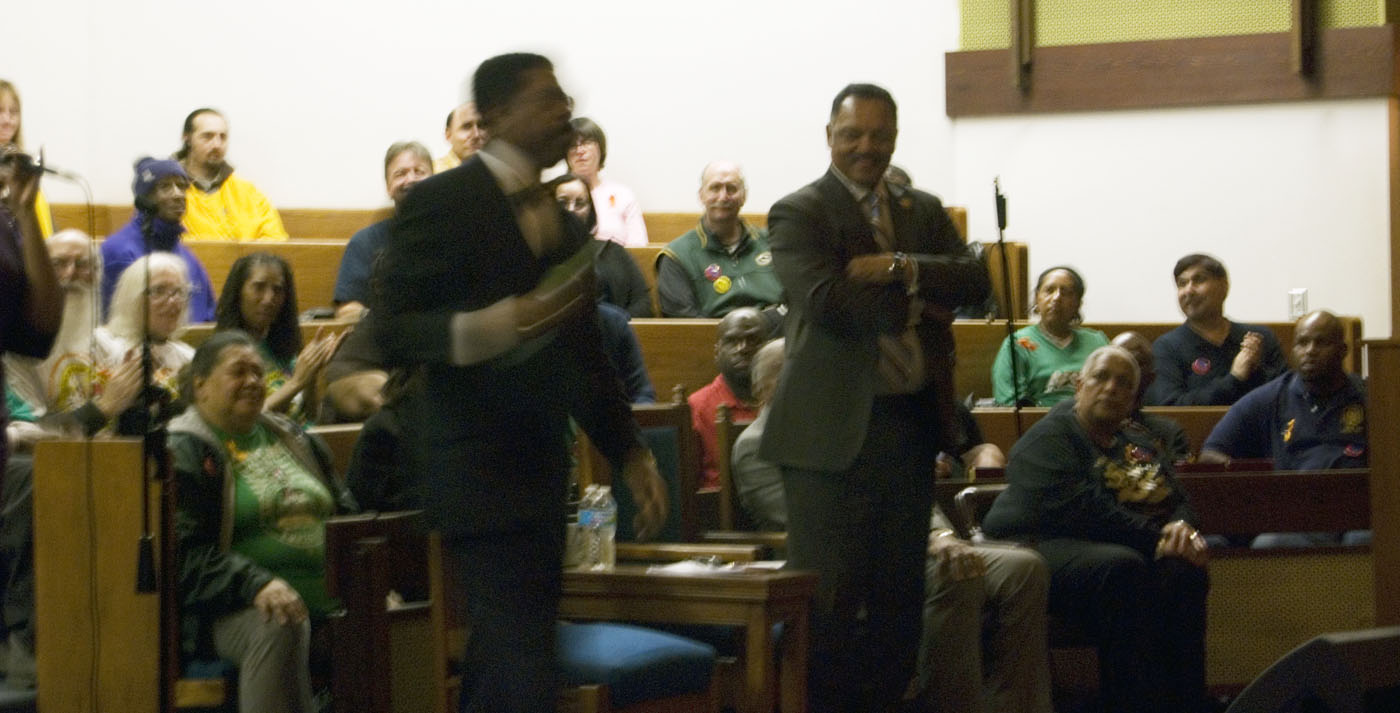
The Rev. Jesse Jackson led a rousing Milwaukee rally that gave vent Friday night to outrage over the abruptly new direction in which Gov. Scott Walker is taking Wisconsin.

“Suddenly we have gone from Wallace to Walker,” Jackson told some 550 cheering people – a full house – at the Metropolitan Missionary Baptist Church, 1345 W. Burleigh St. As an aide to Martin Luther King Jr., Jackson helped challenge the segregationist policies of the defiant 1960s Alabama Gov. George Wallace. Jackson said Wallace was denying black people the right to vote and that now Walker was denying working people the right to collectively bargain.

Jackson called for a mass march for jobs and voter registration in Milwaukee, and an organizing meeting for such a march was set for 6 p.m. Tuesday at the offices of the Milwaukee County Labor Council, 633 S. Hawley Rd.

Another speaker – Sheila Cochran, head of the Labor Council – called Walker “the devil.”

The rally merged two anti-Walker movements. The first came in response to his rejection of $810 million in federal funds to build a high-speed rail line between Milwaukee and Madison – a project that promised to create thousands of jobs. That movement morphed into a general demand for jobs. The second movement came in response to Walker’s effort to strip away almost all collective-bargaining rights from public employees. That movement has featured continuous protests by tens of thousands at the Capitol in Madison and a walkout by Senate Democrats to thwart a quorum and thereby delay action on the bill.

Sheila Cochran
By taking place  in the heart of Milwaukee’s black community, the rally highlights the depth of animosity toward Walker among African Americans – a fact that may be visually lost in the mostly white Madison protest. African Americans make up 6% of Wisconsin residents and live mostly in Milwaukee.

"There will be collective bargaining no matter what the governor does," Jackson thundered.  “The boycott in Montgomery was collective bargaining. The march in Birmingham … was collective bargaining. The march to free South Africa was collective bargaining. The march in Egypt, in Cairo, was collective bargaining. The march in Wisconsin is what collective bargaining looks like."


James Hall
Cochran said, "Scott Walker is the devil and he needs to be stopped." She termed him “foolish” for turning down the $810 million. If Walker was as concerned about the money as he claims to be in making draconian budget cuts, He would have accepted the federal funds and put black people to work, she said. Unemployment is rampant in Milwaukee’s black community.


"He created a hole of some 140-odd million dollars,” she said, referring to the tax cuts he pushed through the Legislature shortly after he was sworn in. “And thern he decided the best way to get it back was off the backs of the people who work for the state."
Fred Kessler

Among others paying for his tax cuts, Cochran said, were grant recipients under Wisconsin Works, the jobs-oriented replacement for welfare. Their grants are being cut.

"We can go up to the capitol and we can scrub it down with holy water," she said.

James Hall, president of the Milwaukee NAACP branch termed Walker’s efforts to strip away bargaining rights "a direct attack on middle-class principles and values." He called collective bargaining a "key factor in allowing people the ability to move into the middle class."

The crowd cheered State Rep. Fred Kessler like a battle-scarred war hero. He told of the Democrats’ losing battle to stop the budget-repair bill in the Assembly. “The battle is not over,” he said, adding that Walker was cutting many valuable programs.

The meeting was sponsored by MICAH (Milwaukee Inner City Congregations Allied for Hope) and the Milwaukee NAACP branch as well as the Amalgamated Transit Union, Milwaukee Area Labor Council,  Voces de la Frontera, League of Young Voters and Wisconsin Citizen Action. 

Monday, January 10, 2011

Grizzled civil rights warriors pass the torch

Reuben Harpole speaks as Harry Oden, George Sanders and Paul Blackman look on.
Milwaukee’s Reuben Harpole grew up at 807 W. Somers St, in the shadow of the Lay’s potato chips and the Wonder bread plants, a stone’s throw from bustling Walnut St., where black-owned restaurants, haberdasheries and other establishments thrived and the Regal Theater swung to the likes of the Duke Ellington and Count Basie.bands.

Wiped out by "progress" - housing projects and a freeway - this one-time hub of black Milwaukee lives only in memories now. It served as a backdrop in the saga of the struggle for racial fairness and justice in the city, as told by Harpole and other oldtimers at a forum the other day.

A side show developed on Facebook when two days prior to the event a young man replied with bahs and humbugs to the forum’s announcement.  

“I see no record of impact they have [on] … epidemic conditions of Black Milwaukee,” he wrote of the panelists, starting a string of back-and-forth commentary

No doubt, members of my father’s generation would be chuckling now. The curse parents secretly bestow on their troublesome offspring – may you have children like you – has been fulfilled.

Back in the 1960s we young know-it-alls scoffed at our elders for accommodating white racism. We confronted it. We marched and picketed and sat in and demanded equal rights. We refused to scrape and bow. No, we weren’t loud about our superiority – well, maybe a few of us were.  Mostly we were just quietly smug. We’re putting our bodies on the line, and you didn’t.

Now what goes around has come around. So a young man attacks a panel of older activists, saying they did nothing for the cause of racial justice, offering as Exhibit A the continuing blight in the neighborhood around Coffee Makes You Black coffee house, 2803 N. Teutonia Ave., where the forum took place. It was titled “Grizzled Black Men Discuss Their Historic and Ongoing Struggle on Behalf of the Black Community.” The eight panelists were all at least 70 years old.

Harpole, black Milwaukee’s oral historian, related pieces of the struggle. He noted the epic push for open housing in the 1960s. And he told of his involvement with The Milwaukee Star in an era when black weeklies were fresh and urgent. He was the newspaper’s advertising director.

Paul Blackman, retired labor leader, recalled a flashpoint in the marathon series of open housing marches, when it encountered violent resistance on the white ethnic south side: "I was on the 16th Street Bridge dodging bottles from some of our Polish neighbors."

He related how he led A. O. Smith steelworkers on strike, shutting down Chrysler, Ford and General Motors in the process. The Milwaukee plant was the world’s largest maker of automobile frames. In the end, the union got everything it wanted. The lesson: "If you are organized, anything is possible.”


My generation was wrong – very wrong – about our elders. We came to realize that it was on their shoulders that we stood as we fought racism. Our parents forged strong families through much work and sacrifice and gave the children the security and strength to permit them to challenge the social order.

Besides, “accomodationist” oversimplifies that generation. My own dad, for instance, refused to surrender his dignity when growing up dirt-poor in Birmingham, Ala., a city synonymous with racial oppression. The rule among kids was that, when the police came, you ran. But according to family lore, my dad refused to run, to the exasperation of his playmates, especially his older brother. My dad was polite in dealing with the police, but he stood his ground.

My father’s generation emerged into adulthood in the 1940s; the panelists did so the next decade, and my wisdom teeth broke out in the ‘60s. The civil rights revolution was mainly waged by the ’50s and ’60s generations.

It is not crystal clear whether the Facebook critic is attacking a whole generation. He faults two of the panelists by name – Harpole and black business advocate Curtiss Harris – charging they have sat on economic development boards with zero benefits for the black community. But he attacks the panel as a whole, too. And since the panelists have been involved in Milwaukee’s and the nation’s broad struggle for racial justice – from Martin Luther King Jr., to Stokely Carmichael, to the Black Panthers – he seems to be pooh-poohing that struggle.

Maybe what’s at work here is the intractability of racism – a phenomenon the struggle brought to light. You get rid of Jim Crow and, as the late NAACP leader Ben Hooks used to put it, his more sophistticated cousin – J. Crow. Esquire – takes over. You integrate the city schools, then whites resegregate by fleeing to the suburbs. Sharecropping replaces slavery, mass imprisonment of black men replaces sharecropping.

In a post after the forum, the Facebook critic said many of the panelists were in denial that the black communioty was in a state of emergency. Trouble is, not one panel member expressed that opinion. In fact, they went in the opposite direction. To wit:

  • Carl Estrada – who was wheelchair-bound and who was an activist in Milwaukee, Detroit and New York City – called Wisconsin the “third most racist state in the country” and urged a grassroots movement to attack the problem.
  • Former State Sen. Monroe Swan intoned, "The proportion of black imprisonment in the state of Wisconsin is the worst of any jurisdiction in this country, thusly the greatest anywhere in the world.” America leads the world in overall incarceration rate.
  • Harpole said getting black businesses a fair share of public contracts remains a struggle.
  • Harris said, “We didn’t have parity when it came to economics and we still don’t.”
  • George Sanders, artist and activist who once worked for The Milwaukee Star, spoke only briefly, but his e-mail recipients know he consantly rants about the sad state of black Milwaukee.

The other panelists were Harry Oden, a former Milwaukee Public Schools principal and a basketball star at the University of Minnesota, and Mason Bullock, a carpenter.

To be sure, the hard-fought civil rights movement fell far short of its goal. As a rule, blacks still don't enjoy the same life chances that whites do. The battered, grizzled civil rights warriors are passing the torch to a new generation.  Now it's up to the Facebook critic and his peers to change the world. Criticism has its place, but, more importantly, they must come up with their own goals, tactics and strategies.  And they shouldn't be too surprised if decades hence a new cocky generation belittles their efforts.


Thursday, December 30, 2010

Busses to go to inaugural protest in Madison


Prayer will take place inside and outside of Monona Terrace in Madison Monday morning. Inside will be a prayer breakfast in honor of the inauguration of Scott Walker as Wisconsin governor. Outside will be a prayer rally in protest of the actions Walker has already taken to scuttle thousands of anticipated jobs in the state.
The rally and other protest activities during Monday’s inauguration will give residents a chance to show the state and the world their anger and concern over the incoming governor’s cancellation of a federally financed, $810 million, 110 miles-an-hour rail line between Madison and Milwaukee.


The rally will take place at 9 a.m. Monday. No passenger train connects Wisconsin’s two biggest cities, so Milwaukeeans who want to participate can board busses at 6:30 a.m. in a parking lot at 27th and Hopkins Sts. MICAH (Milwaukee Innercity Congregations Allied for Hope) has details.  (For background, see my earlier post, "Rail backers to 'crash' Wis. governor's inaugural.")

* * *

Business community paralyzed

Would Milwaukee’s business community have stood silently by had a Democratic governor-elect chased a manufacturing company out of town and rejected hundreds of millions in free economic development money, killing a project that (1) had already hired dozens of construction workers and would eventually have hired hundreds more, (2) would have created dozens of permanent jobs directly and hundreds indirectly and (3) would have linked the state’s two top economic engines by fast passenger rail?  I think not.

The business community’s silence in Walker’s case, I submit, betrays its bias in favor of Republicans. That bias made it too paralyzed to head off a Republican-engineered economic fiasco.

In announcing it would move its manufacturing operation out of Milwaukee in light of the state’s anti-rail climate, train-maker Talgo expressed disappointment about that silence, which, the firm said, stood in contrast with the encouragement it got from business leaders to come to Milwaukee in the first place.

The Metropolitan Milwaukee Association of Commerce blames its non-action on a poll that found its members evenly split on the merits of high-speed rail between Milwaukee and Madison.

* * *

Other states cheer Walker

“California's high-speed rail system is slowly coming together, thanks to a commitment to 21st-century progress and political games over federal funding by the Republican governors of Ohio and Wisconsin.” Fresno Bee.

“Thanks a billion, cheeseheads.” Los Angeles Times.

“California is not too proud to take leftovers.” The Orange County Register

“U.S. Sen. Bill Nelson (D-Fla), welcomed Thursday the news that Florida is getting ‘an early Christmas present.’” News Chief  (Winter Haven, Fla.).


* * *
Let them eat donated goods

Wisconsin Gov. Jim Doyle donated proceeds from his inauguration – $233,000 in 2003, $323,000 in 2007 – to the state's Boys & Girls Clubs. Walker plans to split the proceeds between the state Republican Party and his own campaign chest. He is, however, asking inaugural guests to bring canned goods for the Hunger Task Force. Not a bad idea. Given Walker’s job-killing propensities, hunger may well rise during his governorship.

Thursday, December 9, 2010

NAACP alienates civil rights leaders in Milwaukee

The behavior of the NAACP’s national office in a contentious branch election has left a sour taste in the mouths of much of Milwaukee’s civil rights leadership, which was rooting for the reform slate, the side that eventually won.

Victory was sweet, but not enough to negate the sourness – raising the question of how well will the NAACP’s Baltimore headquarters and the new Milwaukee board relate.

James Hall
Branch President-Elect James Hall, a civil rights attorney, says he’s looking “forward to a positive, constructive” relationship with the national office.

But others involved in the movement to reform the branch cite a continuing sore point: The national office went berserk with suspensions, ousting from the organization eight people in the reform camp. Members of that camp find it hard to forgive and forget while their comrades in struggle remain suspended. Some suspensions are for three years; others are indefinite.

The suspensions are in fact astounding. Kicked out were revered stalwarts of Milwaukee’s black community. The most illustrious is perhaps Lauri Wynn, who in 1973 became the first African American to head the Wisconsin Education Association Council, the state’s umbrella teachers union. Before that, she was on the front lines of the struggle to desegregate Milwaukee’s schools. And in 1983 she became an aide to Wisconsin Gov. Tony Earl.

A picket line protested the suspension of Milwaukee NAACP
members
before voting took place across the street.
Among the other prominent evictees are Wallace White, chair of the Milwaukee African American Chamber of Commerce, vice chair of the Metropolitan Milwaukee Sewerage Commission and CEO of a business consulting firm, and Elmer Anderson, former second-in-command at the Milwaukee Urban League and a former administrator at the Milwaukee Area Technical College.

Their crime? Publicly speaking out against the administration of the local branch.

“Outrageous” and “incredible” was how former Milwaukee Alderman Fred Gordon, a lawyer, described the behavior of the national office, adding, “I think it sucks.”


Picketers end their demonstration with a prayer.
Interviewed on Nov. 20 on his way inside Metropolitan Missionary Baptist Church to vote, Gordon theorized that the national office behaved the way it did because “the current NAACP leadership and the branch have been very close.” He noted that a few years back the branch had hosted the national conference, which, he said, had made money for the NAACP.

Frank Atwater, who formerly headed agencies serving the black community, found particularly incredible the suspension of Wynn. “She’s an icon of the community,” he said.

The national office has not yet responded to my request to give its side of the story.

Widespread discontent about the performance of the branch led to the movement to reform it. A pivotal date in the drama was Sept. 18, when, according to an e-mail message from Hall to his supporters, a branch membership meeting “was improperly adjourned and the lights were turned out and police summoned to disburse approximately 150 members assembled to elect a nominating committee and conduct other business.”

About 50 people re-assembled across the street in a restaurant parking lot and put together a nominating committee. It was members of that committee who got suspensions, which made them ineligible to vote. Representatives of the national office came in and conducted the election instead.

Gloria Gilmer – an educator, civic leader and mathematician – described that meeting as the turning point in that it showed many in attendance how bad the branch leadership was.

Jerry Ann Hamilton, branch president for 10 years, had chosen not to run again and picked her second-in-command, activist and businessman Wendell Harris, to succeed her.

The reform camp had accused the incumbent leadership of mismanagement of funds, nepotism, and failure to deal effectively with a complex of problems crushing the black community, such as high poverty and unemployment rates. That camp has noted that the branch has gone without a financial audit for 10 years.

Hundreds turned out for the election. Many were turned away because, even though they vowed they had paid memberships, NAACP officials could not find their names in their records. Some went home to get proof of membership and returned. Among them was Atwater, who came back with a cancelled check for his membership dues and was allowed to vote. The news media was not allowed inside the church.

Almost everyone appeared to be under the impression that they could run in, vote and leave. But such was not the case. Nominations took place first and the voting procedures were explained. The wait was a couple of hours and more for some voters. A woman who left without casting a ballot said she couldn’t wait any longer. She had a wedding to attend.

"I would say a good 100 people left without voting because they had other plans,” commented Jenelle Elder-Green, an NAACP member who once handled public relations for the Milwaukee Public Schools. “It really is unfair. People were denied the right to vote. If that had happened in any other election, the NAACP would be filing a lawsuit”

Notable about this whole episode is the passion the reformers show for the NAACP.  They could have just given up on the organization and attempted to form an alternate group. But they believe in the NAACP, or at least the ideals of the NAACP. Mary Glass, a suspended member, talks about restoring the NAACP brand, making the organization true to its purpose – a notion echoed by other reformers.

Gilmer said, “I think what happened here can be a resurgence of the NAACP.” She stressed she was referring to the national organization, not just the Milwaukee branch. Reformers have emerged at other troubled branches, she said, and the national office, to judge by its attempts to tamp down reform in Milwaukee, has also lost its way.

Photos by Gregory Stanford


Monday, November 15, 2010

Wisconin Gov.-Elect Walker has a deep-seated hatred for rail

Photo credit: dreamstime_11512691
Hatred of rail most logically explains Wisconsin Gov.-Elect Scott Walker’s torpedoing the planned high-speed train between Milwaukee and Madison. His stated motive – to save Wisconsin taxpayers $7.5 million a year in operating costs – doesn’t compute. After all, the project should easily generate that money and more for the state coffers.

Before I had a chance to post this piece, an alternate explanation emerged: the gobs of money the road builders lavished on the Walker campaign. But the Milwaukee County executive’s phobia about rail goes way back, stunting public transit in Milwaukee for years. Now he has public transportation in a whole state to retard.

Consider these facts:

  • The Republican politician has pledged to attract 10,000 companies to Wisconsin in four years. Yet, almost the first thing he does as governor-elect is to practically shoo a company away, Milwaukee-based high-speed train maker Talgo, which Mayor Tom Barrett and outgoing Gov. Jim Doyle had convinced to open shop in the industrial city. The company has said that, because of Walker’s anti-rail policies, it may move to Illinois, into the open arms of Gov. Pat Quinn.
  • Walker has pledged to bring 250,000 jobs to the state in those four years. Yet, already he has done the opposite, idling dozens of workers who have started to construct the high speed rail line. In killing the project, he would put the kibosh on thousands of construction jobs altogether and lead to the layoffs of scores of engineers and others already hired for the project. Dozens of new jobs – to run the railroad and its stations – won’t be created. He would likely chase away the 125 jobs planned for Talgo. Hundreds of spinoff jobs – at the ice cream parlor that opens near a train station or at the electronics store that must hire due to increased business generated by train-related paychecks – won’t come to be.
  • Walker complains about the state’s fiscal crisis. Yet, he’s thumbing his nose at $810 million in free money – that is, money the state doesn’t have to raise. Sure, he’s asking the feds to redirect this stimulus money to Wisconsin roads, or, in the latest ploy, to existing rail. But that outcome is, as Doyle put it, “pure fiction.” Meanwhile, governors elsewhere, particularly in Illinois and New York, are salivating over these funds. What’s more, if Wisconsin drops the project, the law holds it would have to return millions already spent on it.
  • The thousands of jobs to be generated by the project – the Madison-based Wisconsin Public Interest Research Group puts the number of permanent jobs at 13,000 – should result in state tax payments that would easily cover the $7.5 million in yearly operating costs. But Wisconsin may only have to pay $750,000 – should federal aid cover 90% of the costs, as it already does with the Milwaukee-to-Chicago Hiawatha line.

In short, in killing the Madison-to-Milwaukee rail line, Walker is pursuing a course that would likely cost Wisconsin many times more money than the $7.5 million a year it might save. So the question becomes: Why is he pursuing this insane course? True, the money he’s getting from the road builders is likely a factor, even though the $810 million can’t be used for roads. But the most logical explanation, to borrow from Glenn Beck, is that Walker has a deep-seated hatred for rail.

Milwaukeeans are familiar with this hatred. One of his chief “accomplishments” as Milwaukee County executive was to keep light rail away – for reasons that likewise failed to withstand scrutiny. He called himself protecting the county bus system, from which light rail would drain resources. He depicted himself as champion of the poor (don’t laugh!), who ride the bus, whereas light rail draws the upwardly mobile, quiche-eating crowd.

Some protector he turned out to be. He has the bus system in a death spiral of rising fares, reduced service and falling ridership.

While Walker was saying “no” to light rail, Minneapolis was saying “yes.” And that enlightened city found that light rail 1) drew more riders than expected, 2) in contrast to busses, pulled people out of their cars and onto public transit, 3) increased bus ridership since passengers could use their light rail transfers for the bus and vice versa, 4) boosted business around light rail stops and 5) increased job opportunities for poor people.

Minneapolis could look amused at County Executive Walker’s irrational hatred of rail. But the Minnesota city must be alarmed at Gov. Walker’s hatred. The next leg of high speed rail to be constructed was supposed to connect Minneapolis to Madison and thus to Milwaukee and Chicago. But Walker’s quashing those plans.

The better workers, customers and business people can move around, the more vibrant the economy will be. Walker retarded that movement in Milwaukee County. Now, gads, he’s trying to do for the state what he did for the county.

Sunday, October 31, 2010

In race for governor, Milwaukee county exec blames mayor, exempts self from blame for community's ills

Never mind that, when all of America falls into an economic sinkhole, the source of the problem likely lies outside your city hall or your statehouse. Political ads across the nation are bludgeoning local and state office holders for the mess.


One of the more brazen examples is taking place in the governor’s race in Wisconsin. An ad sponsored by Republican candidate Scott Walker piles Milwaukee’s ills on the shoulders of his Democratic foe, Milwaukee Mayor Tom Barrett

“Barrett’s city has one of the worst job creation records of any big city in the U.S.,” the announcer charges. The voice notes that the city’s August unemployment rate was 11.5% and called Milwaukee the fourth poorest city in the nation. (Actually, dozens of smaller cities are poorer than Beer Town, which is in a twelve-way tie for the-third worst poverty rate among big cities. See analysis by the University of Wisconsin-Milwaukee’s Employment and Training Institute.)

From Scott Walker's campaign site
What makes the ad so nervy is that Walker is acting as if he’s an innocent bystander, with no responsibility for Milwaukee’s ills. He’s Milwaukee County’s top official, for crying out loud. He’s held the post of county executive for eight years. So if the city’s record means, as the ad puts it, “we can’t trust Tom Barrett to turn Wisconsin’s economy around,” ditto for Walker. The last I checked, the city was a big part of the county.

Under Walker, the county’s unemployment rate soared from 4.6% in April of 2009 to 10.5% in March of 2010 – a period when the county lost a whopping 34,000 jobs.

The county exec has claimed exemption from responsibility on jobs. Economic development is not part of his portfolio, he says – a telling attitude. In light of the crying need, he should have made encouraging job creation a top priority. The problem was he remained a bystander – a guilty bystander.

Does Walker think he deserves a pass on the county’s poverty rate, too? Of every six people in the county, one is poor – the tenth worst rate among the 50 biggest counties in the nation. Walker blew chances to tackle poverty. The state stripped from Walker’s portfolio programs to serve the poor on the grounds they were badly run. The Private Industry Council, which does job training, was turned over to the city, and the state itself took over food aid, child care and medical assistance programs "Milwaukee County has demonstrated a sustained inability to successfully provide services to its (poor) customers," the Milwaukee Journal Sentinel quoted a state official as saying in a letter to Walker.

As a legislator Walker got behind a measure that was supposed to take a big bite out of poverty: Wisconsin Works, which ended cash grants to most poor families with children and tied aid to jobs. The theory was that, rather than easing poverty, the grants themselves were causing it by encouraging dependency. So by taking away the grants, you do poor people a favor, ending their dependency and nudging them into the middle-class. Well, the Walker ad itself testifies to the failure of that policy. Wisconsin Works didn’t do what Walker and other backers said it would do. Poverty has only intensified in the city (and in the county).

The county exec touts his penny-pinching budget submissions as his way of attracting businesses. Never mind that the strategy didn’t work. For one, few took his budgets seriously, They were seen as political stunts, his way of claiming he worked to keep taxes low, while leaving to the County Board the heavy lifting of coming up with a realistic budget. For another, the strategy didn’t stop thousands of jobs from vanishing.

Among public officials you can legitimately blame for the nation’s loss of millions of jobs is former President George Bush, who presided over an economic crash after cutting taxes for the wealthy and loosening regulations on businesses – principles that, eerily, Scott Walker holds dear.

Wednesday, October 6, 2010

The storm that rusted the Steel Belt

Detroit – The storm that upended New Orleans came fast and furious. In contrast, notes Political Science Professor Lyke Thompson, "Detroit has endured a slow-moving disaster – a disaster that stretches across decades of deindustrialization."

Lyke Thompson
If you had shot photos daily of Detroit over the last half century or so and then strung them into a fast-playing movie, it would indeed look as if an invisible force was tearing the city apart, destroying thousands of homes, clearing away huge chunks of neighborhoods, idling scores of factories, throwing legions out of work and prompting all manner of heartbreak, much as Katrina did.

So where is Detroit’s federal aid? asks Thompson, director of the Center for Urban Studies at Wayne State University. He points out that New Orleans got many millions from the feds to recover.

That apt question does apply to Detroit especially, but not exclusively. The vortex of forces that has battered the Motor City has played out in other industrial centers across America. The resulting devastation cries out for federal relief – in the form of a vigorous national urban policy backed up with dollars.

Remember when the South was dirt-poor? Well, wipe that outdated image from your head. The industrial North, once the Promised Land to which Southern refugees fled, is now the one with hat in hand.

Just take a look at the 2009 poverty figures the US Census Bureau recently released. All five big cities with the highest share of poor people – Detroit, Cleveland, Buffalo, Milwaukee, St. Louis, in that order – once played starring roles in the Northern Steel Belt, spewing out outboard motors, rubber tires, handyman tools, door locks, tractors, airplane parts, construction beams, lawn mowers, gears, locks, motorcycles, furnaces, glass windows, water meters, railroad tracks, steam engines, mining gear, nuts and bolts, pots and pans, kitchen sinks, and, Detroit’s specialty, automobiles. The work was often hard, but the pay was good, permitting many a strapping lad to muscle his way out of poverty and into the middle class.

That portal to the good life has all but vanished. The Steel Belt has morphed into the Rust Belt. The ranks of the poor have swelled.

Thompson notes that state government, itself reeling from the downturn in the automobile industry, has steadily cut back on the revenue it shares with Detroit. “There should be much more serious attention from the national government," he says.

Robin Boyle, chair of the Department of Urban Studies and Planning at Wayne State, says that revenue sharing money from state and federal governments in America pales by comparison with what European cities get. As reported in a previous post, he notes that Europe further protects its cities by outlawing sprawl, which drains urban centers of resources and people.

Do Europeans have a better attitude toward cities?

No, says Boyle, who grew up in Scotland. They have the same love-hate attitude that you find in America.

Here, in my opinion, hate has the upper hand. In 1975, when Gerald Ford was president and New York City was staring into the abyss of bankruptcy and seeking federal help, the New York Daily News blared on the front page: “FORD TO CITY: DROP DEAD," which seemed to have summed up how the White House felt.

Boyle points to Ronald Reagan, who said in effect: Cities, you’re on your own. Reagan cut back on urban programs right and left.

Professor Thompson points to statistics showing that in some ways the slow-motion storm that chewed up Detroit left this city worse off than is New Orleans today. As the chart notes below, Detroit has higher poverty, unemployment and even housing-vacancy rates than does New Orleans.

The storm that tore Detroit apart wreaked havoc throughout the industrial North. Hence, even Milwaukee outstrips the Big Easy in poverty.

Source: U.S. Census Bureau, American Community Survey 2009
Of course, New Orleans deserves every penny of federal aid it gets. But it shouldn’t have to take a sudden cataclysm to loosen the federal purse strings. The federal government must start treating America’s besieged cities as the national treasures they are.