Saturday, June 25, 2011

Mischief lurks in closed concealed carry records

Guns are not the only things that will be hidden from the public under Wisconsin’s concealed carry law. Any information about the license holder – name, age, residence – will also be secret. That concealment will hamper the ability of the public to monitor the law.
Investigative work by the Los Angeles Times showed that, despite being barred from owning firearms, hundreds of convicted criminals, including rapists and armed robbers, received concealed-carry licenses in Texas, and many then proceeded to commit more crimes, ranging from drunken driving to murder.
Will outlaws likewise get licenses in Wisconsin? Keeping license holders secret will make it tough for the public, including news organizations, to check.
The National Rifle Association has been wildly successful in their campaign to get state legislatures across the country to enact concealed carry laws. In only nine states in the 1980s were you legally able to carry a pistol in your pocket either without a license or with a license that must be given merely for the asking. Now you can do so in 40 states. At the same time, the number of states that completely bar concealed carry has dropped from 15 to 2. Make that one. The Wisconsin Legislature has sent Gov. Scott Walker a concealed carry bill, which he is sure to sign, leaving Illinois as the sole holdout.
The NRA insists on inserting into these laws provisions keeping the records secret, and Wisconsin lawmakers happily obliged. Although all other licenses the state issues – for motorists, barbers, lawyers, dentists, hunters, day care providers and so forth – are open to public inspection, records on concealed carry licenses will be sealed.
Even police officers in hot pursuit of a suspect are barred from asking the state whether the guy they’re after has a license to carry a gun, which, of course, he could use against them. (Only should he produce a license once they nab him will officers be able to check with the state whether the license is authentic.)
Reasons the pro-gun forces give for the secrecy are far-fetched, as illustrated by Richard Pearson of the Illinois State Rifle Association: "Once this information is released, it will be distributed to street gangs and gun-control groups, who will use the data to target gun owners for crime and harassment.” Note that this fantastic argument runs counter to the gun lobby’s own rationale for the unfettered right to firearms. Gun possession makes you safer.
The real reason the NRA insists on keeping concealed-carry records secret is likely that their release could spoil the narrative the organization spouts (as put by the Brady Campaign to Prevent Gun Violence): Good people with guns prevent harm from bad people with guns.
The hard truth the NRA doesn’t want you to know is that some bad people will get the licenses, too, which they will sometimes use to wreak havoc. To keep that secret, the Legislature has shamelessly turned its back on Wisconsin's tradition of open records.

Negative news


The likely purpose of keeping concealed carry records secret is to cut down on the bad press concealed carry gets from time to time. Here’s a sampling of such press. All the gun wielders here boasted concealed carry licenses:

“The mixture of guns and alcohol exploded at a Lynchburg restaurant Saturday night when a customer accidentally shot himself in the thigh with a concealed weapon.” Lynchburg (VA) News & Advance ,

“One Indiana man pressed the barrel of a loaded handgun into the chest of a woman holding her 1-year-old son. Another's handgun was confiscated by police three times – twice for shooting in public. … And in all of these cases – and hundreds of other questionable ones uncovered by The Indianapolis Star – the Indiana State Police granted [the gunmen’s request to carry concealed handguns]. Even worse, many of those people committed subsequent crimes, some with the guns they were legally permitted to carry.” Indianapolis Star,  Oct. 11, 2009

“Houston police said Richard Calderon, 24, hit the teen's mother's car at about 8:20 p.m. Wednesday and then left the scene. The mother … tried to catch up to the vehicle to get its license plate number. As she drove by … , Calderon fired shots at her car, police said. Alexis Wiley, 13, was shot in the head. She was taken to Memorial Hermann Hospital, where she died a few hours later.” KPRC Local 2, Houston, March 5, 2010.

“Jacksonville police said a woman was killed Monday afternoon by what appears to be the accidental discharge of a concealed firearm. Police said a man with a concealed weapons permit went into the Allied Veterans Cyber Center Internet café … Police said the man's gun was mishandled or dropped and discharged, striking a woman in the back. Witnesses said the gun fell from the man's belt.” News4 Jax.com,  Oct. 19, 2009.

“Federal investigators have searched the home of a North Carolina terrorism suspect, seizing counterterrorism literature, ammunition and portable electronics. A search warrant released Wednesday shows agents searched the home of Anes Subasic….The warrant says Subasic had a concealed handgun permit. Agents reported taking boxes of ammunition, knives and an empty box for a 'super sniper' rifle scope. Subasic is one of eight North Carolina suspects accused of plotting international terrorism.” Associated Press, Sept. 30, 2009.

For many more such stories, see the Brady Campaign to Prevent Gun Violence. For an overview of crimes committed by concealed carry license holders, check out the Violence Policy Center.


Sunday, June 5, 2011

My brush with food stamp fraud

I was tempted with welfare fraud some while back. I was putting my groceries in the trunk of my car outside the old Uptown Supermarket on North Ave. in Milwaukee, when a young woman with a cartload of bagged groceries asked me for a ride.

“I’ll give you $10 in food stamps,” she said.

I gave her the ride, but rejected the stamps – and thereby avoided a crime. It is illegal to exchange food stamps except for the purchase of food, as an exposé in Sunday’s Milwaukee Journal Sentinel notes.

Actually, her offer wasn’t much of a temptation. She was plainly needy – sufficient reason to give her a ride. It’s one of the Beatitudes, I believe.

From U.S. Department of Agriculture
Still, I couldn’t help but think that, had I been broke myself with no job in sight – the plight of a whole bunch of people – I doubtless would have accepted the food stamps, middle-class morality be damned. (He who has never fudged on his 1040, cast the first stone.) In fact, I might have hung around the store’s parking lot giving rides for cash or food stamps to people with lots of groceries and no cars.

Which is why I find it hard to get worked up over the Journal Sentinel’s blockbuster story finding that nine people in Milwaukee and 70 nationwide were using Facebook to buy or sell food assistance benefits illegally. The people caught in the newspaper’s dragnet apparently lacked the sophistication to deploy a privacy shield over such transactions – an option Facebook gives them.

My brush with food stamp fraud preceded the Internet’s social networks, which have expanded the reach of people seeking to buy or sell the coupons. So maybe real big-time crime is now afoot. What’s more, the Journal Sentinel (where I spent most of my journalism career) has been doing superb exposés of late. Still, I find it hard to work up outrage over this particular peek at a struggle for survival on the part of poor people.

I don’t know whether my passenger knew that she was proposing to break the law. But she was in a bind. She lived close enough to the store to walk there, but had too many groceries to walk back. She knew she would need a ride, so she frugally reserved enough of her precious food stamps to pay for it.

Though she was ready to break the law, she looked more like a mom struggling to make ends meet than a crook.

Thursday, May 19, 2011

About fire truck chasers and collateral damage

I own a duplex on Milwaukee’s west side, about seven blocks from where I live, and it was set afire. One recent morning, while playing catch-up on putting together my neighborhood newsletter, I got a phone call.

“Are you Gregory Stanford who owns a house on 41st St.? “

“Yes, I am.”

”I can board the house up for you.”

“What do you mean, board it up? The house is not vacant. It doesn’t need boarding up.”
 
“It’s on fire. I’m standing right across the street from the house. Fire trucks are out here. Flames are coming out of the roof.”

So that’s how you learn about a fire at your rental, I thought as I rushed to the scene. Your calamity is somebody else’s opportunity.

As firefighters flooded the roof and the second floor with water, I found myself surrounded by contractors seeking the board-up work. A police detective rescued me.

I once covered fires as a newspaper reporter. I combed the crowds for witnesses and victims – anybody with a link to the burning structure. But I never ran into this phenomenon: contractors pitching their services. I knew about the ambulance chasers – lawyers hawking their services after a car crash – but not about the fire truck chasers. Then again the last fire I covered was in the 1980s.

The mom who lives in the upstairs flat was huddled in an alley with her two grown daughters. They confirmed what I had guessed. The fire was set, and the likely suspect was the ex-boyfriend of the younger daughter. The couple had once lived downstairs and when they broke up, the flat was vandalized, reportedly by him – an incident for which he’s facing charges.

She and he have a baby, And he had come to the house the night before the fire ostensibly to see the child, the daughter said. (I had instructed her never to let him on the premises again.) Then she spotted him the next morning in the neighborhood as she was leaving to take the baby to the day care center.

The fire investigator said the side door was kicked in, and fuel appeared to have been taken from the lawnmower I had in the basement. The fire started in the second-floor living room. Thank goodness, nobody was home. I was between tenants downstairs.

Check your insurance. I was under-insured. The last time I got the bill, I  remarked aloud that the amount of coverage listed was not enough and that I was going to get more. I was still intending to do that when the fire broke out. Don’t you follow suit.  As it turned out, the settlement I received matched the vastly deflated assessment value of the house, but it does not come anywhere close to the quotes I’ve gotten so far to rebuild.

In the opinion of the claims adjuster and the fire investigator, despite extensive damage, the duplex was not totalled. The fire was confined to the front rooms upstairs and the front of the attic. The rest of the structure suffered smoke and water damage.

The truth of the matter is that, after a fire, immediate board-up is a necessity. Contractors’ coming to you does save you the trouble of going through the Yellow Pages. The tough part is choosing the right contractor. I ignored the advice of the insurance company and instead gave work to an African-American firm with the proper bona fides – a firm I figured was outside the good ole boy’s network that leads to contracts.

In my immediate neighborhood houses remain boarded up for months, even years – giving me the impression that I had at least two or three months to weigh my options. Wrong. The city building inspector is acting wth lightning speed in my case, condemning the building and ordering it razed even as I continue to get quotes on reconstruction.
I had  kept the property in good shape, recently spending a small fortune on a new roof and a rebuilt chimney. Not too long ago, I rebuilt the entire porch, upstairs and downstairs. My property record downtown is clean.

I can’t help but think about the prime suspect. I doubt that he ever thinks about me. It was his ex-mate, not I, who was on his mind when he vandalized the downstairs and later torched the upstairs. Yes, I may be out tens of thousands of dollars, but that’s just collateral damage in his holy war against his ex-woman.

This reckless, self-centered buffoon is behind bars, where he needs to remain for a long, long time.

Saturday, April 16, 2011

A tightly guarded secret: Dems do better on economy

As a rule, the economy does better when a Democrat occupies the White House. That’s a clear-cut, longstanding statistical fact, which holds up whether you’re looking at jobs, the stock market, the nation’s total output of goods and services or some other economic measure. (See citations below.)

Now here’s what I puzzle over: How come this amply documented fact is such a well-kept secret?

Just imagine for a moment that the two parties’ economic records were switched. Every man, woman, child, cat and dog in America would know that the economy does better under Republican presidents than under Democratic ones, so powerful is the right-wing publicity machine. Fox News, talk radio and conservative think tanks would constantly hammer on that fact. And in reporting on budget debates, the mainstream media would routinely insert a boilerplate line noting the superior performance of the economy when a Republican is the chief executive.

But it’s the Dems that own the better record, so their accomplishments go unnoticed. Meanwhile, the GOP makes up in repetition what it lacks in a record. For instance, the party and its media spokespeople keep asserting several times a day that cutting taxes even on the wealthy creates jobs. Never mind that President George W. Bush spectacularly demonstrated otherwise. Make a dubious assertion often enough, and it starts sounding like solid fact.

Interestingly, all income sectors – the poor and the rich as well as everybody in between – do better under a Democratic president. Sure, the rich pay more in taxes, but because the economy is doing so well, they easily make up the difference with stock dividends and other income.

By the way, Bush’s fiscal policies (like President Reagan’s before him) have led to whopping budget deficits, which have spilled over into the Obama years – spillage that  the right-wing publicity machine has exploited. Thus, President Obama’s getting the rap. Republicans are going spastic over deficit spending, arguing it is a blight on America and must be wiped out. They skip over one little detail: Their party is the one largely responsible for that spending.

The major parties have two different economic approaches. Republicans tend to push money up the income scale by reducing programs for the poor and the middle class and cutting taxes for the rich. Democrats tend to push money down that scale by enhancing programs for the poor and the middle-class and raising taxes on the rich. Also, the GOP  tends to relax regulations on the marketplace, and the Dems tend to tighten the regs.

The results over decades are in: The Democratic approach apparently works better – a fact that is relevant in the present budget debate, in which House Repubicans are supporting Wisconsin Congressman Paul Ryan’s budget bill, which is, in today’s parlance, the Republican approach on steroids.


Articles on economic data showing better performance under Democratic presidents:

“Congresswoman says Democratic presidents create more private-sector jobs,” St Petersburg Times .

“How the U.S. Economy Performed Under Democratic and Republican Presidents,” Currency Thoughts.

“REPUBLICANS vs. DEMOCRATS ON THE ECONOMY,” The Washington Monthly

“Politicians Lie, Numbers Don't,” Slate

“Would Obama’s Plan Be Faster, Fairer, Stronger?” The New York Times. (See chart showing all income sectors do better under Democrats.)

“Democratic vs. Republican Presidents: Economic Prosperity,” Blue Works Better

“Which Party Has Posted The Strongest Economic Numbers In The Modern Era?” DaveManuel.com


Articles on the budget deficit:
"Critics Still Wrong on What’s Driving Deficits in Coming Years," Center on Budget and Policy Priorities.  

“CNN Fact Check: Is the annual deficit under Obama 12 times the deficit under Republicans?” CNN.  

Friday, March 25, 2011

Worker rights coalition may fracture over residency

A mighty coalition came together to fight the Republican effort to weaken collective bargaining for public employees in Wisconsin. Now a Republican effort to void one result of collective bargaining in Milwaukee – the requirement that teachers and police officers live in the city – has the potential of driving a wedge through that coalition.

Bargaining rights for public employees enjoy widespread support among Milwaukee residents, but so does the residency rule for public employees – a rule some public-sector unions hate. Thus, as the proposal to do away with that rule sails through the Legislature, many Milwaukee residents will find themselves at odds with government workers the residents are now backing.

The residency rule is a vital self-help tool for cities, which find themselves assailed on all borders. An unspoken but real struggle over class and race has raged for untold decades in metropolitan America. The metro area is the organic whole. Suburbs are artificial communities that cropped up primarily to wall out poor people (and non-whites) while sucking in the wealth of cities. The result is that the hub city shoulders the metro area’s burden of poverty and its related ills with fewer and fewer resources. One resource the city does have is its own jobs. By reserving them for its own residents, the city fights poverty, boosts local commerce and stabilizes neighborhoods.

The residency requirement is a big reason why, as bad as poverty and unemployment are in Milwaukee, the city is not quite Detroit, whose decline sped up after the requirement was outlawed there.

Getting rid of the residency rule was long a top agenda item of Milwaukee teacher and police unions. They failed to reach that objective at the bargaining table or in court. So they resorted to political wheeling and dealing.

The Milwaukee Teachers Education Association, however, dropped that effort about 15 years ago, when the reform faction took over. One reform leader told me she personally backed the residency rule, but the union never took its repeal off its agenda; the union just stopped pushing repeal. Notably, MTEA President Mike Langyel has not voiced enthusiasm about the current repeal drive.

The Milwaukee Police Association never lost enthusiasm. The historically anti-black union, which gives aid and comfort to Republican politicians, has abstained from the coalition backing bargaining rights. In a transparent effort to reward the MPA, Gov. Scott Walker exempted police and fire unions from the bill to curb those rights, although several such unions have nonetheless joined the coalition.
After it started downplaying the residency rule, the MTEA became more community-friendly – doubtless one reason it enjoys broad residential support in its battle for bargaining rights. In contrast, the MPA is still widely perceived as hostile to the community.

Milwaukee residents recently rallied for the bargaining rights of public employees.
Gov. Scott Walker and other Republicans have tried to stoke resentment among taxpayers against public employees, saying they get the generous pay and benefits that average workers don’t enjoy. That rhetoric has thus far had only limited success. But lifting the residency rule could make the ground more fertile for such thinking in Milwaukee. Not only are municipal employees more generously paid than the average Milwaukee worker, but many don’t think enough of the city to live here. These suburbanites are taking away jobs that could go to city residents and our hard-earned taxes are supporting their comfortable lifestyles outside the city.

The racial implications of repealing the residency rule are obvious in a city whose suburbs are among the whitest in America. Also, the city’s decline, which repeal of the residency rule will accelerate, will hurt city employment in the long run due to a withering tax base. Public employee unions could and should head off fractures in the labor rights coalition by doing an about face and endorsing Milwaukee’s residency rule.


Further reading:
Why city needs residency rule”  by Gregory Stanford
 “The residency rule helps keep Milwaukee strong” by Milwaukee Common Council President Willie Hines
The Barrett Report” (3/18/11)  by Milwaukee Mayor Tom Barrett

Saturday, March 5, 2011

Walker draws ire at rally led by Jackson

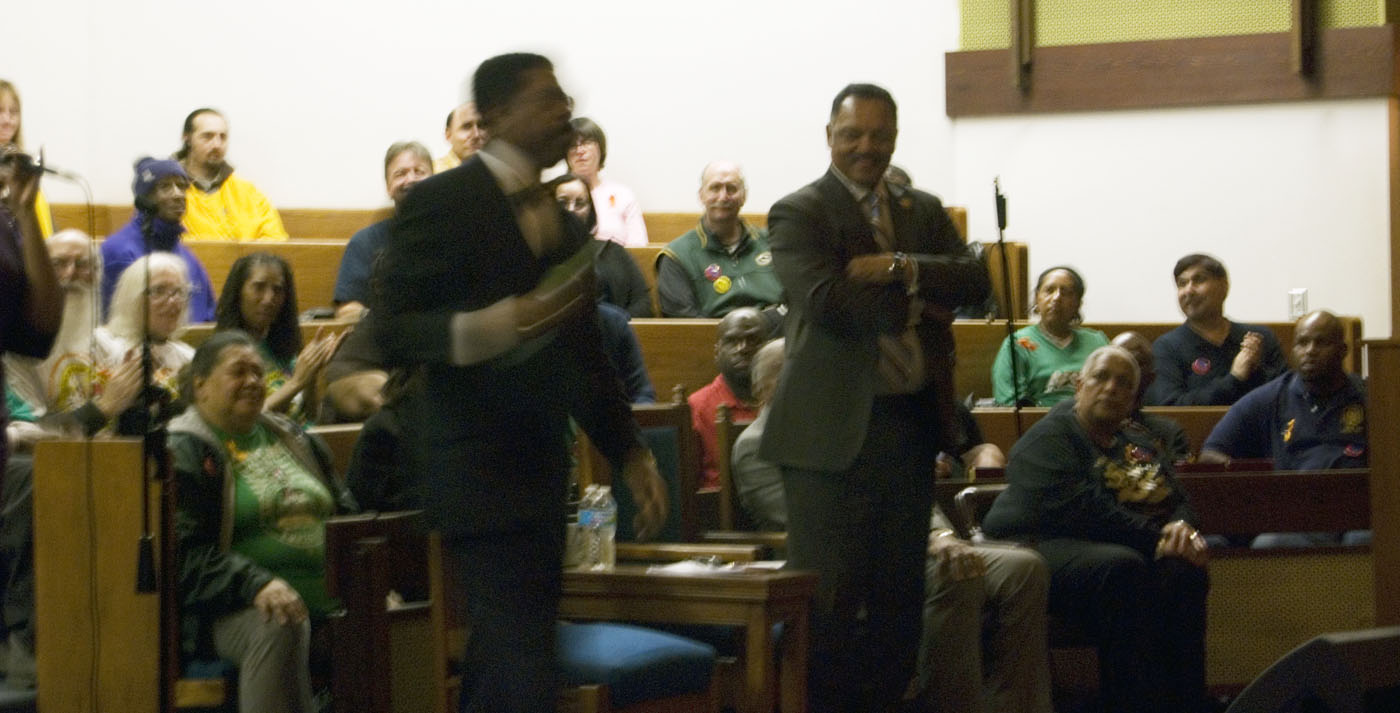
The Rev. Jesse Jackson led a rousing Milwaukee rally that gave vent Friday night to outrage over the abruptly new direction in which Gov. Scott Walker is taking Wisconsin.

“Suddenly we have gone from Wallace to Walker,” Jackson told some 550 cheering people – a full house – at the Metropolitan Missionary Baptist Church, 1345 W. Burleigh St. As an aide to Martin Luther King Jr., Jackson helped challenge the segregationist policies of the defiant 1960s Alabama Gov. George Wallace. Jackson said Wallace was denying black people the right to vote and that now Walker was denying working people the right to collectively bargain.

Jackson called for a mass march for jobs and voter registration in Milwaukee, and an organizing meeting for such a march was set for 6 p.m. Tuesday at the offices of the Milwaukee County Labor Council, 633 S. Hawley Rd.

Another speaker – Sheila Cochran, head of the Labor Council – called Walker “the devil.”

The rally merged two anti-Walker movements. The first came in response to his rejection of $810 million in federal funds to build a high-speed rail line between Milwaukee and Madison – a project that promised to create thousands of jobs. That movement morphed into a general demand for jobs. The second movement came in response to Walker’s effort to strip away almost all collective-bargaining rights from public employees. That movement has featured continuous protests by tens of thousands at the Capitol in Madison and a walkout by Senate Democrats to thwart a quorum and thereby delay action on the bill.

Sheila Cochran
By taking place  in the heart of Milwaukee’s black community, the rally highlights the depth of animosity toward Walker among African Americans – a fact that may be visually lost in the mostly white Madison protest. African Americans make up 6% of Wisconsin residents and live mostly in Milwaukee.

"There will be collective bargaining no matter what the governor does," Jackson thundered.  “The boycott in Montgomery was collective bargaining. The march in Birmingham … was collective bargaining. The march to free South Africa was collective bargaining. The march in Egypt, in Cairo, was collective bargaining. The march in Wisconsin is what collective bargaining looks like."


James Hall
Cochran said, "Scott Walker is the devil and he needs to be stopped." She termed him “foolish” for turning down the $810 million. If Walker was as concerned about the money as he claims to be in making draconian budget cuts, He would have accepted the federal funds and put black people to work, she said. Unemployment is rampant in Milwaukee’s black community.


"He created a hole of some 140-odd million dollars,” she said, referring to the tax cuts he pushed through the Legislature shortly after he was sworn in. “And thern he decided the best way to get it back was off the backs of the people who work for the state."
Fred Kessler

Among others paying for his tax cuts, Cochran said, were grant recipients under Wisconsin Works, the jobs-oriented replacement for welfare. Their grants are being cut.

"We can go up to the capitol and we can scrub it down with holy water," she said.

James Hall, president of the Milwaukee NAACP branch termed Walker’s efforts to strip away bargaining rights "a direct attack on middle-class principles and values." He called collective bargaining a "key factor in allowing people the ability to move into the middle class."

The crowd cheered State Rep. Fred Kessler like a battle-scarred war hero. He told of the Democrats’ losing battle to stop the budget-repair bill in the Assembly. “The battle is not over,” he said, adding that Walker was cutting many valuable programs.

The meeting was sponsored by MICAH (Milwaukee Inner City Congregations Allied for Hope) and the Milwaukee NAACP branch as well as the Amalgamated Transit Union, Milwaukee Area Labor Council,  Voces de la Frontera, League of Young Voters and Wisconsin Citizen Action. 

Sunday, February 27, 2011

Arousing the green-eyed monster

In their campaign to stifle the rights of public employees in Wisconsin, the would-be masters of the universe are fanning the embers of a human vice: envy.

You no longer have the nifty pension or health insurance or the decent pay or the union protection that you or your parents once enjoyed. You may have even lost your job. Yet, look at those fat-cat public employees, strutting around with their good salaries and benefits and their union rights – all made possible with your hard-earned money. That’s so unfair. They should suffer just like you do.

The upshot is that this message is being brought to the working stiffs in the private sector by the very people who helped make them suffer: our corporate overlords (think brothers Charles and David Koch among others). They helped shove those workers onto a downward economic spiral. Now these tycoons are counting on their victims to reach up and grab their public-sector brothers and sisters and pull them down that spiral, too.

Some Wisconsin workers have bought that message, as indicated by signs on display at a relatively small counter-protest at the Capitol in Madison on Feb. 19. (See photos on this page.) One sign – “IT’S MY MONEY NOT YOUR HUMAN RIGHT” – particularly reflects the anti-government message coming out of talk radio and right-wing think tanks (financed by our corporate oligarchy) over the last three decades.

We don’t tell workers at our cable TV company or our computer store they shouldn’t bargain for fair wages because that’s our money they’re dealing with. Rather, we figure that once the money leaves our hands, it’s no longer ours. What’s ours is the 200 TV channels or the 500-gigabyte computer we got in exchange.

Likewise, in exchange for the money we give government, we get valuable services. Public-sector workers lock up bad guys, plow snow on the route to work, teach first graders their numbers and letters, make sure rat feces don’t flavor our pasta dish, put out house fires before they reach our homes and maintain our favorite parks.

True, unlike in the private sector, we are not just consumers; we are also collectively the boss of public employees – which gives us the right to debate how the money ought to be spent, but also the moral duty to be a fair boss and to give just compensation for work done. Collective bargaining helps ensure we fulfill that duty.

Fortunately, the appeal to envy has had only limited success, polls suggest. Most people in Wisconsin and in America side with the effort of public employees to maintain their bargaining rights (though Wisconsin residents are evenly split on Gov. Scott Walker’s budget bill). Doubtless, labor’s readiness to concede on all economic issues has helped it in the battle of public opinion. The governor’s refusal to compromise in the face of that concession shows that his real goal is to castrate the unions.

A big reason America’s middle class has receded is that labor unions have eroded in the private sector. One possible response of workers there is to resent their compatriots in the public sector, where labor strength has grown over the last several decades. But most workers have not succumbed to that temptation. Rather, they astutely recognize that the middle class is less likely to rebound if public-sector labor unions lose their strength, too.