Thursday, January 6, 2011

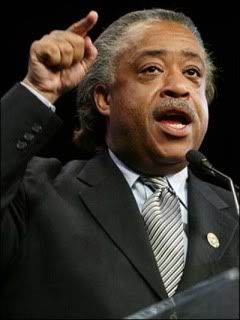
Sharpton to speak on jobs in Milwaukee

MySpace Comments
Al Sharpton Phot
Bulletin: Rev. Al Sharpton's trip to Milwaukee has been postponed until Tuesday. He will speak at 5 p.m.  at the New Covenant Missionary Baptist Church, 2315 N. 38th St. The civil rights leader will also broadcast his radio show from Milwaukee. Organizers said his trip was delayed because flight schedules did not allow him to arrive in time to do his Sunday show from Milwaukee. 

This post has been updated and corrected. Earlier version misidentified Rev. Brisco's position at his church.

A budding movement for jobs in Milwaukee will get a boost Sunday from the Rev. Al Sharpton. The civil rights leader will arrive in town and is slated to speak at 9:30 a.m. at the New Covenant Missionary Baptist Church, 2315 N. 38th St., and at 11:45 a.m. at Zion Hill Missionary Baptist Church, 1825 W Hampton Ave.

Protest over Gov. Scott Walker’s derailment of high-speed rail is morphing into a movement demanding jobs. In scotching the federally financed, $810 million rail line between Milwaukee and Madison, Walker wiped out the thousands of jobs experts say the project would have spurred.

Walker had complained that the state would have been saddled with yearly operating costs, as much as $7.5 million, even though the project should have generated enough added state revenue - by boosting personal income and sales of merchandise and thus income and sales taxes - to cover those costs.
The governor also prompted train maker Talgo to announce it would take its manufacturing operation out of Milwaukee. Occupying a refurbished manufacturing plant on the north side, an area of super-high unemployment, Talgo had stood as a symbol of hope.
MICAH (Milwaukee Innercity Congregations Allied for Hope) had designated Sunday Emergency Jobs Sunday and has called on member churches to talk about the city’s job crisis. The Rev. Willie Brisco, associate minister at New Covenant, heads MICAH.

Rev. F. L. Crouther is pastor of New Covenant, and Rev. Russell Williamson is pastor of Zion Hill.
MICAH is a member of a coalition organizing the jobs movement. Other members are:  Amalgamated Transit Union, Milwaukee Area Labor Council,  Voces de la Frontera, League of Young Voters and Wisconsin Citizen Action.

Tuesday, January 4, 2011

Rail backers demand jobs at Madison protest

Madison, Wis. – As power shifted here from one major state party to the other Monday, five bus loads of Milwaukee residents rode into town demanding jobs. They invited new-Gov. Scott Walker to appear at a community meeting in Milwaukee to explain why he killed a project that would have led to employment for thousands.

The 250 Milwaukeeans were joined in front of the Capitol by roughly 100 others, many of them students. The crowd heard labor leader Sheila Cochran bellow: “He says that the state of Wisconsin is open for business. I want him to know that we mean business.”

She and others noted that, in killing the $810 million high-speed rail project connecting Milwaukee and Madison, Walker was going in the opposite direction of his promise to create 250,000 jobs.

A coalition of organizations, including MICAH (Milwaukee Innercity Congregations Allied for Hope), sponsored the protest. Their first stop was Monona Terrace for a prayer rally outside as Walker attended a prayer breakfast inside. The Rev. Willie Brisco, who heads MICAH, says he gave a Walker representative an invitation to attend a community meeting in Milwaukee and that she promised to make sure Walker got the invitation. The governor would choose the date.

The group is calling on Walker to bring good jobs to Milwaukee and to explain face to face how he’s going to do that and to invest in the Milwaukee north side complex that contains train maker Talgo, which has said it would move its manufacturing operation to another state because of Walker’s antagonism toward rail.

The group prayed and sang freedom songs, such as “This Little Light of Mine” and “We Shall Overcome.”

The sky was grey and the air was cold.  But it was not the biting cold participants had feared.

Later in the morning, the protestors rallied at the Capitol, where the Rev. Gregory Lewis said, “We are living in times of desperation” due to the absence of jobs. That desperation is leading to crime, he said, volunteering that his church office was recently broken into and its contents  rifled and items taken. He led a chant: “We need jobs.”

The Rev. Leondis Fuller said, “We have a governor who's being inaugurated today, and I want you to know he does not care about workers.”

Saying the people have the power to fight back, he added: “The fight is going to be long, the fight is going to be hard. but we're going to have to stay the course because the Republicans in this building behind us, they do not care about you and I.”

He said that “Walker had already sent jobs out of state.” Because of Walker’s action, train maker Talgo plans to move its manufacturing operation from Milwaukee to a state friendlier to rail. What’s more, the federal government has redistributed Wisconsin’s $810 million to other states, where the money will create many jobs.

The federal government would have fully financed construction of the Milwaukee-to-Madison line. Walker objected to the state’s picking up as much as $7.5 million a year in operating costs, even though the project promised to generate enough taxes – by boosting sales and personal income in the state – to cover those costs.

Said another speaker at the rally: “We are tired of going to job fairs where there are no jobs.”


After the rally the crowd broke up into groups stationed in front of the entrances to the Capitol and chanted slogans and held picket signs.

Inside, Walker was being sworn in as governor, and a new regime was beginning – a regime seemingly callous to the desperate plight of workers in Milwaukee.


Photos by Gregory Stanford and Cynthia Henry

Thursday, December 30, 2010

Busses to go to inaugural protest in Madison


Prayer will take place inside and outside of Monona Terrace in Madison Monday morning. Inside will be a prayer breakfast in honor of the inauguration of Scott Walker as Wisconsin governor. Outside will be a prayer rally in protest of the actions Walker has already taken to scuttle thousands of anticipated jobs in the state.
The rally and other protest activities during Monday’s inauguration will give residents a chance to show the state and the world their anger and concern over the incoming governor’s cancellation of a federally financed, $810 million, 110 miles-an-hour rail line between Madison and Milwaukee.


The rally will take place at 9 a.m. Monday. No passenger train connects Wisconsin’s two biggest cities, so Milwaukeeans who want to participate can board busses at 6:30 a.m. in a parking lot at 27th and Hopkins Sts. MICAH (Milwaukee Innercity Congregations Allied for Hope) has details.  (For background, see my earlier post, "Rail backers to 'crash' Wis. governor's inaugural.")

* * *

Business community paralyzed

Would Milwaukee’s business community have stood silently by had a Democratic governor-elect chased a manufacturing company out of town and rejected hundreds of millions in free economic development money, killing a project that (1) had already hired dozens of construction workers and would eventually have hired hundreds more, (2) would have created dozens of permanent jobs directly and hundreds indirectly and (3) would have linked the state’s two top economic engines by fast passenger rail?  I think not.

The business community’s silence in Walker’s case, I submit, betrays its bias in favor of Republicans. That bias made it too paralyzed to head off a Republican-engineered economic fiasco.

In announcing it would move its manufacturing operation out of Milwaukee in light of the state’s anti-rail climate, train-maker Talgo expressed disappointment about that silence, which, the firm said, stood in contrast with the encouragement it got from business leaders to come to Milwaukee in the first place.

The Metropolitan Milwaukee Association of Commerce blames its non-action on a poll that found its members evenly split on the merits of high-speed rail between Milwaukee and Madison.

* * *

Other states cheer Walker

“California's high-speed rail system is slowly coming together, thanks to a commitment to 21st-century progress and political games over federal funding by the Republican governors of Ohio and Wisconsin.” Fresno Bee.

“Thanks a billion, cheeseheads.” Los Angeles Times.

“California is not too proud to take leftovers.” The Orange County Register. 

“U.S. Sen. Bill Nelson (D-Fla), welcomed Thursday the news that Florida is getting ‘an early Christmas present.’” News Chief  (Winter Haven, Fla.).


* * *
Let them eat donated goods

Wisconsin Gov. Jim Doyle donated proceeds from his inauguration – $233,000 in 2003, $323,000 in 2007 – to the state's Boys & Girls Clubs. Walker plans to split the proceeds between the state Republican Party and his own campaign chest. He is, however, asking inaugural guests to bring canned goods for the Hunger Task Force. Not a bad idea. Given Walker’s job-killing propensities, hunger may well rise during his governorship.

Friday, December 17, 2010

Rail backers to "crash" Wis. governor's inaugural

Seething over the jobs lost because of the cancellation of high-speed rail in Wisconsin, a church full of people in Milwaukee cheered calls Thursday night to “crash” Gov.-Elect Scott Walker’s inauguration on Jan. 3.

“What Scott Walker has done is despicable, is shameful,” Father Tom Mueller, an Eastern Orthodox priest, told the more than 300 people on hand. “He slams the city. He spits on the city. … He doesn’t care what we say. We have to take our message where he is.”
Father Tom Mueller


Added Marilyn Miller of the Reformation Lutheran Church: “We need to crash the party on Jan. 3.” Organizers did not specify what they meant by “crash.”

The emotional meeting was a reminder that the high speed rail issue is not just a political game. It affects real people. It could mean the difference between having a livelihood and not having one.


A long string of residents went to the microphone at New Hope Baptist Church on Milwaukee's north side and expressed dismay and anger that Walker turned down an opportunity to create thousands of jobs, which they described as badly needed. Several said they themselves were unemployed. Others spoke of the travails of living in a community with high unemployment.
Marilyn Miller

A church coalition called MICAH joined forces with labor unions and other groups to sponsor Thursday night’s event and the upcoming demonstration in Madison.


Walker had vowed to reject $810 million in federal money, mostly for building a high-speed rail system between Milwaukee and Madison.  As a consequence, the federal government took most of the money away and handed it out to rail projects in other states. Construction had begun on the project, but present Gov. Jim Doyle halted it in light of Walker’s statements.

Citing Walker’s anti-rail policies, Talgo, which makes trains, plans to move its manufacturing operations out of Milwaukee in 2012, but would leave a maintenance crew behind.

Walker’s rationale has been that, although the feds would fully cover construction, he didn’t want the the state to be saddled with up to $7.5 million a year in operating costs. The rationale makes little sense because the project itself should have generated more than enough state taxes to cover those costs.

“When you throw away $810 million, that’s a colossal mistake,” one audience member, a pastor, told the crowd.

“Who in his right mind gives away all that money?” asked a young woman.

Said another speaker,: “This man is on drugs. … That’s the only thing I can figure out. His brains are fried.”

Eddie Tipton, a bus driver said of Walker, “He doesn’t care about you or me.”

Rubin (Ben) Ciriacks carried a sign with the numbers “250,000,” the amount of jobs Walker has pledged to create in Wisconsin, and “-55,” the number of workers idled by the  halt in high speed rail construction that was already under way. During Walker’s tenure, he said, keep asking, “Where are the jobs?”

The Rev. Leonard Fuller, who works with ex-cons, noted the tough time they had finding jobs, the lack of which fuels crime.

One woman advocated “following Scott Walker everywhere he goes.”

Attendees signed up to go to the protest in Madison on Jan. 3 and to get others to go.

The sponsors of the event: Milwaukee Innercity Congregations Allied for Hope (MICAH), the Services Employees International Union, the Amalgamated Transit Union, the Milwaukee Area Labor Council, the League of Young Voters and Wisconsin Citizen Action.

Photos by Gregory Stanford

Thursday, December 9, 2010

NAACP alienates civil rights leaders in Milwaukee

The behavior of the NAACP’s national office in a contentious branch election has left a sour taste in the mouths of much of Milwaukee’s civil rights leadership, which was rooting for the reform slate, the side that eventually won.

Victory was sweet, but not enough to negate the sourness – raising the question of how well will the NAACP’s Baltimore headquarters and the new Milwaukee board relate.

James Hall
Branch President-Elect James Hall, a civil rights attorney, says he’s looking “forward to a positive, constructive” relationship with the national office.

But others involved in the movement to reform the branch cite a continuing sore point: The national office went berserk with suspensions, ousting from the organization eight people in the reform camp. Members of that camp find it hard to forgive and forget while their comrades in struggle remain suspended. Some suspensions are for three years; others are indefinite.

The suspensions are in fact astounding. Kicked out were revered stalwarts of Milwaukee’s black community. The most illustrious is perhaps Lauri Wynn, who in 1973 became the first African American to head the Wisconsin Education Association Council, the state’s umbrella teachers union. Before that, she was on the front lines of the struggle to desegregate Milwaukee’s schools. And in 1983 she became an aide to Wisconsin Gov. Tony Earl.

A picket line protested the suspension of Milwaukee NAACP
members
before voting took place across the street.
Among the other prominent evictees are Wallace White, chair of the Milwaukee African American Chamber of Commerce, vice chair of the Metropolitan Milwaukee Sewerage Commission and CEO of a business consulting firm, and Elmer Anderson, former second-in-command at the Milwaukee Urban League and a former administrator at the Milwaukee Area Technical College.

Their crime? Publicly speaking out against the administration of the local branch.

“Outrageous” and “incredible” was how former Milwaukee Alderman Fred Gordon, a lawyer, described the behavior of the national office, adding, “I think it sucks.”


Picketers end their demonstration with a prayer.
Interviewed on Nov. 20 on his way inside Metropolitan Missionary Baptist Church to vote, Gordon theorized that the national office behaved the way it did because “the current NAACP leadership and the branch have been very close.” He noted that a few years back the branch had hosted the national conference, which, he said, had made money for the NAACP.

Frank Atwater, who formerly headed agencies serving the black community, found particularly incredible the suspension of Wynn. “She’s an icon of the community,” he said.

The national office has not yet responded to my request to give its side of the story.

Widespread discontent about the performance of the branch led to the movement to reform it. A pivotal date in the drama was Sept. 18, when, according to an e-mail message from Hall to his supporters, a branch membership meeting “was improperly adjourned and the lights were turned out and police summoned to disburse approximately 150 members assembled to elect a nominating committee and conduct other business.”

About 50 people re-assembled across the street in a restaurant parking lot and put together a nominating committee. It was members of that committee who got suspensions, which made them ineligible to vote. Representatives of the national office came in and conducted the election instead.

Gloria Gilmer – an educator, civic leader and mathematician – described that meeting as the turning point in that it showed many in attendance how bad the branch leadership was.

Jerry Ann Hamilton, branch president for 10 years, had chosen not to run again and picked her second-in-command, activist and businessman Wendell Harris, to succeed her.

The reform camp had accused the incumbent leadership of mismanagement of funds, nepotism, and failure to deal effectively with a complex of problems crushing the black community, such as high poverty and unemployment rates. That camp has noted that the branch has gone without a financial audit for 10 years.

Hundreds turned out for the election. Many were turned away because, even though they vowed they had paid memberships, NAACP officials could not find their names in their records. Some went home to get proof of membership and returned. Among them was Atwater, who came back with a cancelled check for his membership dues and was allowed to vote. The news media was not allowed inside the church.

Almost everyone appeared to be under the impression that they could run in, vote and leave. But such was not the case. Nominations took place first and the voting procedures were explained. The wait was a couple of hours and more for some voters. A woman who left without casting a ballot said she couldn’t wait any longer. She had a wedding to attend.

"I would say a good 100 people left without voting because they had other plans,” commented Jenelle Elder-Green, an NAACP member who once handled public relations for the Milwaukee Public Schools. “It really is unfair. People were denied the right to vote. If that had happened in any other election, the NAACP would be filing a lawsuit”

Notable about this whole episode is the passion the reformers show for the NAACP.  They could have just given up on the organization and attempted to form an alternate group. But they believe in the NAACP, or at least the ideals of the NAACP. Mary Glass, a suspended member, talks about restoring the NAACP brand, making the organization true to its purpose – a notion echoed by other reformers.

Gilmer said, “I think what happened here can be a resurgence of the NAACP.” She stressed she was referring to the national organization, not just the Milwaukee branch. Reformers have emerged at other troubled branches, she said, and the national office, to judge by its attempts to tamp down reform in Milwaukee, has also lost its way.

Photos by Gregory Stanford


Monday, November 15, 2010

Wisconin Gov.-Elect Walker has a deep-seated hatred for rail

Photo credit: dreamstime_11512691
Hatred of rail most logically explains Wisconsin Gov.-Elect Scott Walker’s torpedoing the planned high-speed train between Milwaukee and Madison. His stated motive – to save Wisconsin taxpayers $7.5 million a year in operating costs – doesn’t compute. After all, the project should easily generate that money and more for the state coffers.

Before I had a chance to post this piece, an alternate explanation emerged: the gobs of money the road builders lavished on the Walker campaign. But the Milwaukee County executive’s phobia about rail goes way back, stunting public transit in Milwaukee for years. Now he has public transportation in a whole state to retard.

Consider these facts:

  • The Republican politician has pledged to attract 10,000 companies to Wisconsin in four years. Yet, almost the first thing he does as governor-elect is to practically shoo a company away, Milwaukee-based high-speed train maker Talgo, which Mayor Tom Barrett and outgoing Gov. Jim Doyle had convinced to open shop in the industrial city. The company has said that, because of Walker’s anti-rail policies, it may move to Illinois, into the open arms of Gov. Pat Quinn.
  • Walker has pledged to bring 250,000 jobs to the state in those four years. Yet, already he has done the opposite, idling dozens of workers who have started to construct the high speed rail line. In killing the project, he would put the kibosh on thousands of construction jobs altogether and lead to the layoffs of scores of engineers and others already hired for the project. Dozens of new jobs – to run the railroad and its stations – won’t be created. He would likely chase away the 125 jobs planned for Talgo. Hundreds of spinoff jobs – at the ice cream parlor that opens near a train station or at the electronics store that must hire due to increased business generated by train-related paychecks – won’t come to be.
  • Walker complains about the state’s fiscal crisis. Yet, he’s thumbing his nose at $810 million in free money – that is, money the state doesn’t have to raise. Sure, he’s asking the feds to redirect this stimulus money to Wisconsin roads, or, in the latest ploy, to existing rail. But that outcome is, as Doyle put it, “pure fiction.” Meanwhile, governors elsewhere, particularly in Illinois and New York, are salivating over these funds. What’s more, if Wisconsin drops the project, the law holds it would have to return millions already spent on it.
  • The thousands of jobs to be generated by the project – the Madison-based Wisconsin Public Interest Research Group puts the number of permanent jobs at 13,000 – should result in state tax payments that would easily cover the $7.5 million in yearly operating costs. But Wisconsin may only have to pay $750,000 – should federal aid cover 90% of the costs, as it already does with the Milwaukee-to-Chicago Hiawatha line.

In short, in killing the Madison-to-Milwaukee rail line, Walker is pursuing a course that would likely cost Wisconsin many times more money than the $7.5 million a year it might save. So the question becomes: Why is he pursuing this insane course? True, the money he’s getting from the road builders is likely a factor, even though the $810 million can’t be used for roads. But the most logical explanation, to borrow from Glenn Beck, is that Walker has a deep-seated hatred for rail.

Milwaukeeans are familiar with this hatred. One of his chief “accomplishments” as Milwaukee County executive was to keep light rail away – for reasons that likewise failed to withstand scrutiny. He called himself protecting the county bus system, from which light rail would drain resources. He depicted himself as champion of the poor (don’t laugh!), who ride the bus, whereas light rail draws the upwardly mobile, quiche-eating crowd.

Some protector he turned out to be. He has the bus system in a death spiral of rising fares, reduced service and falling ridership.

While Walker was saying “no” to light rail, Minneapolis was saying “yes.” And that enlightened city found that light rail 1) drew more riders than expected, 2) in contrast to busses, pulled people out of their cars and onto public transit, 3) increased bus ridership since passengers could use their light rail transfers for the bus and vice versa, 4) boosted business around light rail stops and 5) increased job opportunities for poor people.

Minneapolis could look amused at County Executive Walker’s irrational hatred of rail. But the Minnesota city must be alarmed at Gov. Walker’s hatred. The next leg of high speed rail to be constructed was supposed to connect Minneapolis to Madison and thus to Milwaukee and Chicago. But Walker’s quashing those plans.

The better workers, customers and business people can move around, the more vibrant the economy will be. Walker retarded that movement in Milwaukee County. Now, gads, he’s trying to do for the state what he did for the county.

Wednesday, November 3, 2010

Once again economy trumps everything

No, it wasn’t Obamacare. No, it wasn’t the deficit. No, it wasn’t the excessive partisanship in Congress. No, it wasn’t the bailout. No, it wasn’t even high taxes.

It remained the economy, Stupid.
.
Voters were lashing out in pain at the polls Tuesday, to the benefit of the out party, the Republicans.

The ejected Democrats fell victim to the Great Recession, which rolls on endlessly. They didn’t create the downturn. In so far as elected officials are to blame, Republicans deserve more of the rap because of their unswerving support for the fiscally reckless, oversight-eschewing policies of George Bush.

But the economy was too slow to recover after the Democrats took power, so they paid the price. Even exceptional lawmakers, like Sen. Russ Feingold of Wisconsin, went down.
U.S. Sen. Russ Feingold

Maybe President Obama should have heeded the advice of economist-columnist Paul Krugman and did a bigger, more aggressive stimulus package. Sure, the Tea Party types would have had even bigger conniption fits than they did. But the result could well have been a faster recovery and thus a happier electorate and continued Democratic control of the House. The stickler, of course, would have been getting a bigger package passed.

Republicans risk trouble if they act on the false belief it was their message that won the day. They claim the people don’t want what Republicans derisively call Obamacare. But try repealing it, and watch the howls of protest. Health care reform helps people much more than it hurts anybody.

Republicans may delude themselves into believing that the people want to renew Bush’s tax cuts for the wealthy. But those cuts failed to keep us out of the Great Recession and are likely to continue to flop at producing jobs, which are what the people really want.

Republicans may think they were elected to balance the budget by cutting spending. But such action could slow the economy and prolong the recovery and thus alienate the electorate. (See earlier post, "The deficit in Republican thinking.")

There is a silver lining for Democrats. According to the exit polls reported on TV, they overwhelmingly won the youth vote. Trouble is, young people didn’t vote in as big a number as they did two years ago – a failure that allowed the Republicans to romp. Still, the G.O.P. remains a dying party, with only enough strength now to score victories when young people stay home.

But those young people will mature and thus vote more often. At the same time the ranks of the elderly G.O.P. will shrink due to deaths. What’s more, two groups that have sought refuge in the Democratic Party – African Americans and Latinos – are expanding.

Yes, Tuesday was bad for Democrats. But they mustn’t take the loss personally. The electorate was in pain and had to lash out at somebody. What’s more, better days lie ahead for the Dems and, if they stay true to their principles, the country.